
Balcony leaks at the railing are prevented at one of three points in the project lifecycle. In design, the post never penetrates the membrane: an integrated stanchion-mounted system ties the structural anchor to the waterproofing termination so there is nothing for sealant to fail at. In detailing for a surface-mount or face-mount railing, the work is in sealant chemistry, drainage geometry, movement tolerance, and inspection timing. In repair, diagnosis comes before resealing leading to balcony leak prevention.
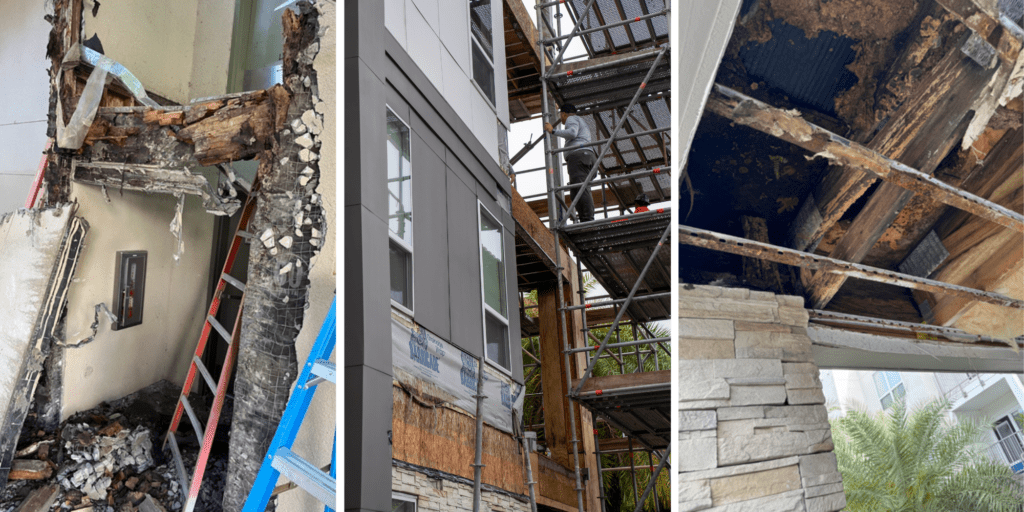
How do you prevent balcony leaks at the railing?
Two readers tend to land on this question. One is designing a building and trying to detail the railing-to-waterproofing connection before construction starts. The other is on a callback inspection, looking at staining on the soffit below a deck and trying to figure out what to do.
The right answer depends on where the project sits in its lifecycle. There are three practical paths, and they map to three different decision points. The further upstream the prevention happens, the less work the sealant has to do later.
Path one: eliminate the penetration
The most reliable prevention is the one that does not ask sealant to keep a balcony watertight for the life of the building. If the post never penetrates the membrane, there is nothing for the sealant to fail at.
This is what an integrated stanchion-mounted railing accomplishes. The stanchion sets first, anchored into the structural substrate. The waterproofing membrane terminates over the embed pan, which seals the perimeter of the stanchion as part of the waterproofing scope. After the topping concrete is poured and cured, the aluminum railing post drops over the cured stanchion and locks with set screws. The membrane is never pierced after the fact.
Not every stanchion-mounted product handles the assembly this way. Some systems treat the stanchion as a structural anchor and leave the waterproofing termination as a separate sealed detail. The Formulated Materials Integrated Balcony Railing System integrates the stanchion, the embed pan, and the membrane termination into a single engineered assembly, which is the difference that removes the post-install penetration. For a fuller definition of the category and how it sits in a typical balcony assembly, see What is a stanchion-mounted railing?
This path is open while the project is in design or pre-construction. It needs a concrete-topped balcony over a waterproofed substrate, with the railing scope sequenced before the topping pour. If those conditions hold, this is the right answer. If the project is already framed and the membrane is detailed for surface-mount posts, the path closes.
Path two: detail the penetration
For face-mount and surface-mount railings, prevention happens in the detail. The post is going through the membrane. The work is to make that penetration as durable as the rest of the assembly, which is a different problem than the assembly was originally designed to solve.
Sealant chemistry is where most projects miss. The membrane manufacturer publishes a compatibility list, and the railing installer needs to be reaching for a sealant on that list rather than whatever tube is in the truck. A high-modulus sealant on a low-modulus membrane will tear at the bond line under thermal cycling regardless of how clean the application is.
Flashing geometry is the next layer. The penetration should sit at a high point in the slope, where water runs past it instead of pooling at the seam. Movement tolerance follows: posts and decks move, and the seal between them needs enough elongation to absorb that movement without failing in shear. Rigid sealant on a moving post is a callback waiting to happen.
The last piece is sequencing. The penetration detail has to be inspected before it gets covered by topping or finish. Once it is buried, the assembly is committed.
Where these come apart is at the trade handoff. The waterproofer specifies one sealant, the railing installer brings another, and neither party owns the inspection. Coordinated specification fixes that, but only if it is documented before the work starts.
This path is the right answer when the project specifies surface-mount or face-mount railings and the detail is still open for revision. It is the most common situation in commercial work, where the waterproofing scope and the railing scope sit with different trades. That is also why it produces the most callbacks.
Path three: manage what’s already there
For retrofit and repair, the work shifts from prevention to containment. Something is already leaking, or the building owner wants to stop a leak before it shows up on a soffit.
Diagnosis comes first. The same staining can come from a sealant adhesion failure, a flashing geometry problem, or a substrate movement issue. Resealing without diagnosing means applying the wrong fix to whatever is wrong. The diagnostic framing in What causes balcony railing leaks? walks through how to identify the failure mode before committing to a repair.
After the failure mode is identified, two questions decide the repair. Is the new sealant compatible with the existing membrane and with whatever residual sealant is on the substrate? Test on a small area before committing the perimeter. And does the repair reach the cause behind the joint? A post that moves because the framing is undersized will keep cracking the seal. A flashing that was cut short will keep letting UV reach the membrane. Resealing the joint without addressing the cause buys time and nothing more.
If the assembly is being rebuilt anyway, the first path opens back up. A repair that includes a new topping slab can re-detail the railing as integrated rather than surface-mount.
How to choose
The path is decided by where the project sits in its lifecycle. In design with the assembly not yet poured, path one is open and almost always the right answer. With surface-mount or face-mount railings already specified and the detail still open, path two is where the prevention happens. With the railing already installed and the goal being to stop a leak, the work is in path three. The exception is a balcony being rebuilt, where path one opens back up because the topping slab is coming out anyway. When the project sits between two paths, default to the upstream one. The cost of moving up while the assembly is on paper is low. After construction, the cost climbs.
For the FM product line that supports these scenarios, see the Integrated Balcony Railing System.