
Pull a railing post off a leaking balcony and the story is almost always the same. There is a fastener through the membrane causing balcony railing leaks. There is sealant around the fastener. The sealant has failed, or the membrane has failed where it meets the fastener, or both. The water is finding the easiest path down through the assembly, and the easiest path is the hole someone drilled after the waterproofing was already installed.
That is the headline. Every failure mode below is a variation on the same root cause. The penetration is the leak. Everything else is how the penetration fails.
This piece walks through the five failure modes in the order a contractor sees them on callback inspections. If you are looking for the category-level definition, see What is a stanchion-mounted railing?
Direct penetration at the post anchor
This is the most common failure mode and the easiest to identify. The railing was post-installed. Lag bolts, anchors, or structural screws were driven through the finished surface, through the waterproofing membrane, and into the substrate underneath. The seal at each fastener is the only thing keeping water out of the assembly.
What you see on a callback: water staining on the soffit directly under a post base, or efflorescence trailing down the fascia from the post location. Pull the post and the membrane around the fasteners is wet, sometimes degraded, sometimes torn where the fastener flexed.
What is happening underneath: the membrane was punctured during install, the punctures were sealed with caulk, and the caulk is doing the long-term work of a waterproofing system. It is not designed for that.
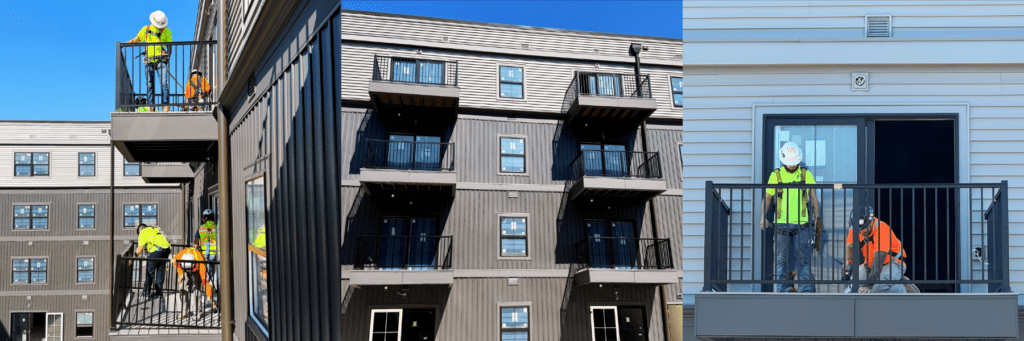
Sealant failure around the penetration
The assembly held for a few seasons. Then the sealant failed before the rest of the assembly did. This is the second most common pattern, and it is often misread as a membrane failure.
What is happening underneath: sealant has a service life. On a balcony, it is also taking UV, thermal cycling, and any movement the railing transmits to the post base. When the sealant goes before the membrane goes, the leak path opens up at the joint between the two materials.
What you see on a callback: a visible crack, gap, or missing bead of sealant at the post base. The membrane underneath may still be intact. Water is entering through a sealant joint that has lost adhesion, lost flexibility, or simply weathered out of service.
Wrong Bolt Sealing Methodology
A commonly accepted and deeply flawed method of sealing bolts is to just heap gobs of sealant on top of them and hope for the best. Think of a paint can that has been left open for a span of time, whereby a skin of cured paint forms above the remaining wet paint. The same process happens with sealants that are liberally applied in a volcano-like form atop the bolted hardware. The deeper reaches of this method are often found to be uncured months later, after the balconies have failed.
Mounding up sealant atop these bolts can prove challenging to smooth. Bumpy surfaces will create bond issues and voids between the sealant and the waterproof membrane. Conforming a 60mil waterproof membrane will be impossible over poorly tooled sealant.
Movement at the penetration
Railings move. Wind load, occupant loads, thermal expansion, and thousands of small flexes over the assembly’s service life all add up. If the post is rigidly fastened through the membrane, the movement transfers directly to the seal.
What you see on a callback: hairline cracks radiating out from the post base in the sealant or the membrane itself. The post may show some rocking when you push it laterally. The sealant looks intact at first glance but cracks when probed.
What is happening underneath: cyclical movement at the penetration is fatigue-loading the sealant joint. The seal does not fail all at once. It develops microcracks. Water finds them long before a visual inspection catches them.
Wrong sealant chemistry
This one shows up on projects where the railing scope and the waterproofing scope did not coordinate. The railing installer brought a tube of whatever sealant was in the truck. It does not bond to the membrane.
What you see on a callback: sealant that has cleanly debonded from the membrane surface, often peeling away in a single piece. The sealant itself may still be intact. It just never adhered to what it was supposed to seal against.
What is happening underneath: most silicones do not bond to most waterproofing membranes. STPE, polyurethane, and membrane-specific sealants are usually required. If the railing installer is not using a sealant approved for the membrane system, the joint was compromised before the post ever moved.
Concentrated load at the penetration point
Railings transmit code-required loads back to the structure. On a post-installed railing, that load is carried through the same fasteners that pass through the membrane. The membrane has to live next to a high-stress connection without being part of the load path.
What you see on a callback: deformation around the post base, sometimes a slight depression in the topping or finish layer. On older balconies, the membrane near the fasteners may show stretching, tearing, or thinning where the load is concentrated.
What is happening underneath: the membrane is not a structural component and was not designed to share a load transfer point with a railing anchor. When the design treats the post penetration as both the structural anchor and a sealed waterproofing detail, the waterproofing loses.
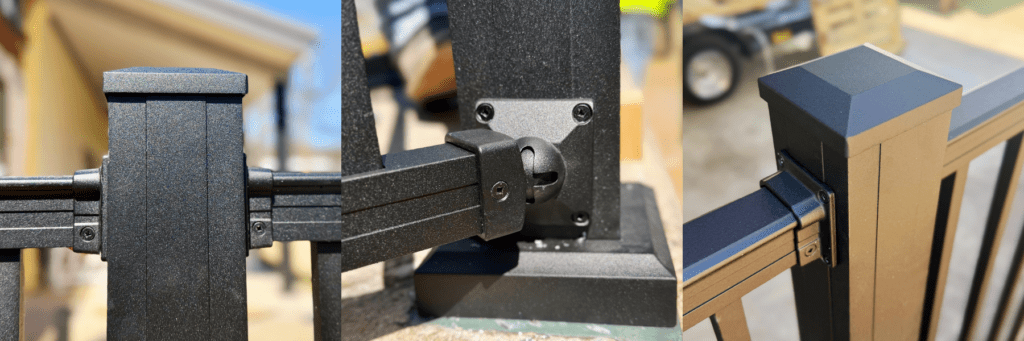
Diagnostic checklist for callback inspections
Use this when a balcony comes back with a leak that points at the railing.
- Is the leak directly under a post base, or does it track to one?
- Is the sealant around the post base intact, cracked, or debonded?
- Does the post move when you push it laterally?
- Was a membrane-compatible sealant specified, and was that the sealant actually used?
- Is there visible deformation, staining, or substrate damage around the fasteners?
Most balcony railing leaks will answer yes to at least three of those. The pattern is consistent because the failure mechanism is consistent.
Balcony Railing Leaks
Every failure mode above traces back to the same condition: a railing that was installed through the waterproofing assembly after the waterproofing was finished. Sealant chemistry, movement tolerance, load path, and inspection access are all downstream of that one decision.
The alternative is to integrate the railing connection into the waterproofing assembly during construction rather than fastening through it afterward. The post mounts to a stanchion or anchor set and sealed before the topping is poured, and the membrane terminates around the anchor instead of being penetrated by it. The Integrated Balcony Railing System is built on that approach. The embed pan handles the transition where the post would otherwise pass through the membrane.