The original sequence: gypsum first, drywall after
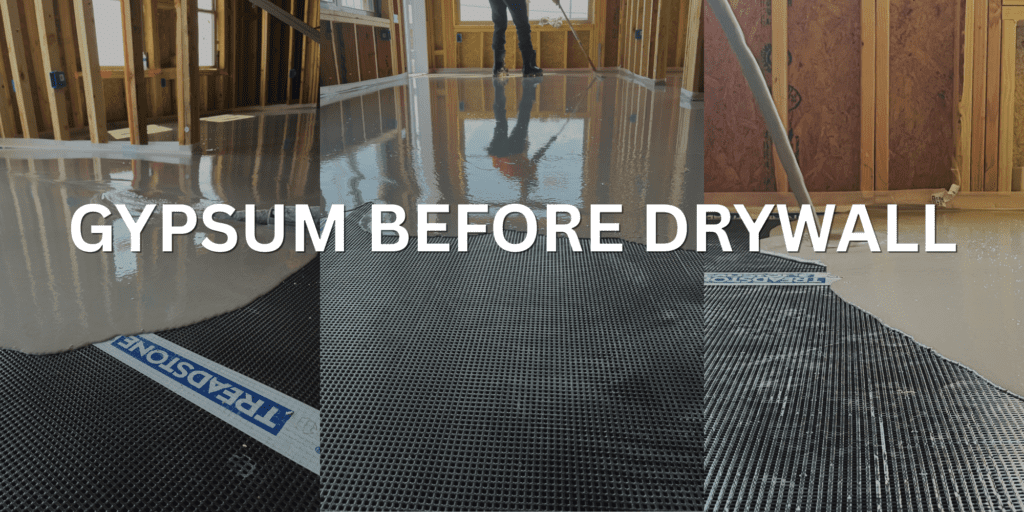
Before acoustic sound mats became standard in multifamily construction, the gypsum pour came first. Frame the structure, sheath the floor, pour the gypsum, then bring in the drywall and finish trades. The reasoning was practical: a cured gypsum floor is the cleanest, flattest surface to work from, and it lets every following trade run on a finished slab. Therefore, the best option is gypsum before drywall.
There was also a structural reason. Drywall delivery carts and cabinet deliveries are heavy. A loaded drywall cart concentrates several thousand pounds onto a small wheel footprint, and the load travels across every square foot of the floor before the building is finished. On a bare wood subfloor, that kind of point load causes deflection — and deflection causes problems for everything that comes after.
Why sound mats forced a sequencing change
When acoustic underlayments became code-required and standard in multifamily, the sequence changed — not because anyone wanted it to, but because the early sound mats made the original sequence impossible. Legacy sound mats are soft. They use a compressible matrix — entangled monofilament, low-density rubber, or open foam — to interrupt the structural sound path. That softness is what gives them their acoustic rating. It’s also what made them incompatible with heavy floor loads.
The failure mode was predictable. Pour the gypsum over a soft sound mat, cure it, then roll a loaded drywall cart across it. The mat compresses under the cart wheels. The rigid gypsum slab on top doesn’t bend with it — it cracks. Once a multifamily floor cracks under drywall delivery, the gypsum repair is real money, the schedule slips, and the warranty conversation gets ugly.
The industry’s response was to flip the sequence: hang drywall first, then pour gypsum after. This kept the heavy delivery loads off the unsupported gypsum-over-soft-mat assembly. It worked, but it gave up everything that made gypsum-before-drywall valuable in the first place.
What changed: a sound mat that doesn’t compress
Treadstone Elite uses a fundamentally different acoustic principle. Instead of a soft, compressible matrix, Elite isolates sound through engineered air voids in a virtually incompressible structure. It takes 20,000 pounds per square foot to compress Elite by a single millimeter. That’s 20 times the compression resistance of typical monofilament sound mats — and it’s well above anything a drywall cart, cabinet delivery, or finish trade is going to put on the floor.
With Elite under the gypsum, the assembly behaves like a rigid system again. The mat doesn’t deform under construction loads. The gypsum on top doesn’t crack. Paired with Treadstone FR25 or FR30, you have a fire-rated, acoustically rated, structurally stable floor system that can take everything multifamily construction throws at it — including the original gypsum-before-drywall sequence.
The schedule advantage: six weeks on a typical project
The reason teams are switching back to gypsum-before-drywall isn’t nostalgia. It’s speed. Large multifamily projects that have made the switch are reporting six-week reductions in overall build schedule. That’s not a small efficiency gain — that’s six weeks of carrying costs, six weeks of construction loan interest, and six weeks earlier to lease-up.
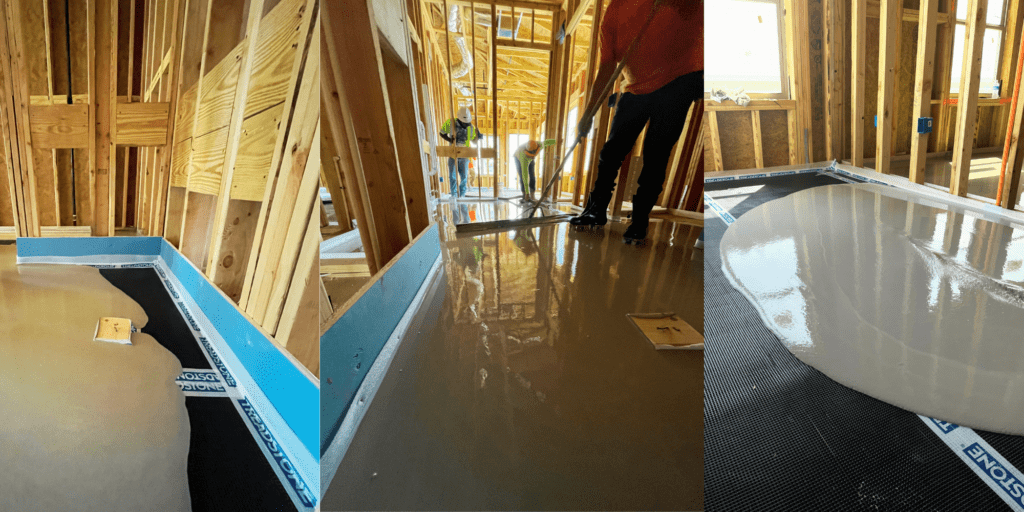
The savings come from several places. The gypsum cures faster without drywall hung — there’s no wallboard to disrupt airflow or trap moist air against the slab. Drywall and gypsum trades can run on different floors in parallel instead of waiting for each other. Punch list items related to drywall water-staining at the base disappear because there’s no drywall in the room when the wet pour happens. Bottom plates stay dry. Electrical boxes stay clean. The entire bottom-of-wall detail is cleaner because the wall didn’t exist when the floor was poured.
The drywall-getting-wet issue is already solved
The standard objection to gypsum-before-drywall is that wet pours can splash or migrate into wall framing and damage subsequent drywall installation. That concern reflects how the work was done before modern detailing existed. Today, a specialized perimeter tape applied at the bottom of stud walls before the pour creates a clean termination — the gypsum stops cleanly at the wall line, the bottom plate stays protected, and the drywall installer arrives to a wall ready for hanging. The tape detail takes minutes per linear foot. It eliminates the issue.
The one limitation: framing detail
There’s one structural prerequisite for gypsum-before-drywall, and it’s worth being explicit about: the wall framing has to use a double bottom plate. The drywall installer needs anchorage above the cured gypsum surface for hanging the drywall and securing trim. With a single bottom plate, the gypsum pour comes flush with or above the top of the plate, leaving nothing for the drywall to attach to.
A double bottom plate gives the drywall installer the second plate above the gypsum line — clean substrate, full anchorage, no compromise. Most multifamily wood-frame projects already use double bottom plates for other reasons (sole plate isolation, fire blocking, structural redundancy), so this isn’t a major change for most projects. Single-plate framing is the only condition where gypsum-before-drywall isn’t an option.
When to make the switch
If your project uses double bottom plates and Treadstone Elite (or a comparably incompressible acoustic mat), you can run the sequence today. Schedule gypsum after rough-in and before drywall hanging. Apply perimeter tape at all wall lines. Pour, cure, and turn the floor over to drywall. The trade sequence collapses, the cure is faster, and the punch list shrinks. The schedule savings are real — and they’re recoverable on the very first project that runs the sequence.